
Islamic Principles, Sunnah
Why Allah Warned You Specifically About These Three Months in a Row
May
“Indeed, the number of months with Allah is twelve months in the register of Allah, [from] the day He created the heavens and the earth; of these, four are sacred. That is the correct religion, so do not wrong yourselves during them.”
Sūrat at-Tawbah, 9:36
There are moments in a believer’s life when the calendar is not merely a sequence of days but a divine summons. Allah, in His infinite wisdom, did not create all moments equally. Just as He chose certain lands, Makkah, Madinah, Jerusalem, and certain individuals – the Prophets – for special honour, He also selected certain stretches of time and elevated them above all others.
Among these are the four sacred months in which the sanctity of human life, the gravity of deeds, and the weight of consequences are all magnified. Three of them arrive consecutively, one after another, forming an unbroken corridor of honour that the Prophet ﷺ described with stunning clarity in his Farewell Sermon:
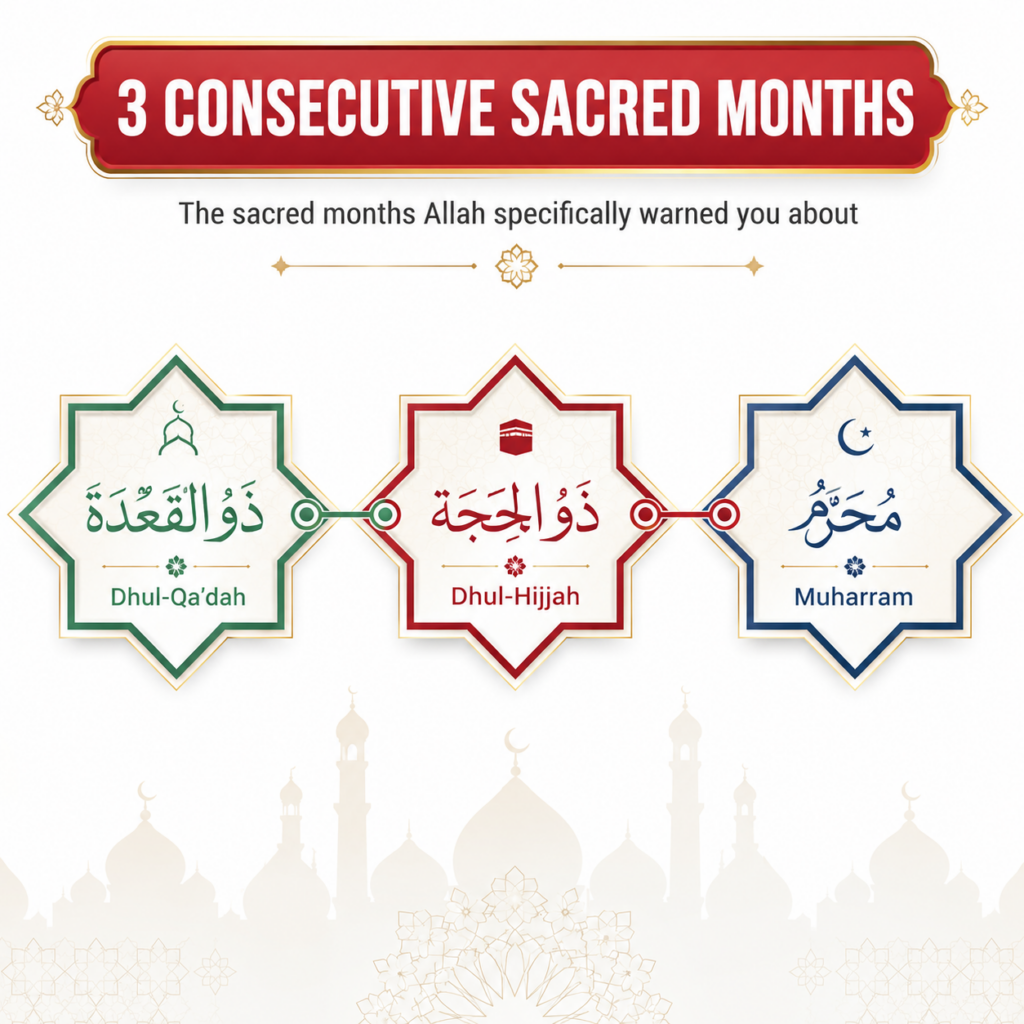
“The year consists of twelve months, of which four are sacred: three consecutive months — Dhul Qa’dah, Dhul Hijjah, and Muharram — and Rajab Mudar, which comes between Jumadah and Sha’ban.”
Sahih al-Bukhari and Muslim
Three consecutive months, flowing into one another without pause. This is not a coincidence in the Islamic calendar; it is a mercy wrapped in a test – an extended season of divine favour in which every believer is being observed, weighed, and given the opportunity to rise.
The Three Consecutive Months
1. Dhul Qa’dah (ذو القعدة)
The month of rest and preparation. Historically, fighting was forbidden so that pilgrims could journey safely to Makkah.
2. Dhul Hijjah (ذو الحجة)
The month of Hajj, containing the greatest ten days of the year and the unparalleled Day of ‘Arafah.
3. Muharram (المحرم)
The first month of the Islamic year, described by the Prophet ﷺ as “the month of Allah” — a title that signifies immense honour.
The Warning: “Do Not Wrong Yourselves In Them”
This divine instruction is weighty enough to make a believer pause: “Do not wrong yourselves during them.” But what does it truly mean to wrong oneself—and why are these months singled out?
The great Companion and scholar Abdullah Ibn ‘Abbas (رضي الله عنهما) explained this with remarkable precision. He said regarding the sacred months:
“Allah singled out four months and made them sacred, and He magnified their sanctity. He made sinning in them greater [in consequence] than sinning in other months, and He made righteous deeds and their reward therein greater.”
Tafsīr Ibn Kathīr
The scholar Qatādah (رحمه الله) further said:
“Indeed, oppression in the sacred months is greater and more serious in sin than oppression in other months, even though oppression is always grave. But Allah multiplies whatever He wills of His affairs.”
Tafsīr al-Ṭabarī
This reflects a foundational principle: the sanctity of time amplifies the weight of actions. Just as sins in the Haram of Makkah are more serious, so too are sins in the sacred months. This is not injustice; it is the logic of honour. When a guest is given a seat at the royal table, his misbehaviour is far more glaring than the same act in the marketplace.
But notice the wording: “Do not wrong yourselves during them.” Allah directs the warning inward. Every sin, at its core, is self-harm. The one who lies, backbites, neglects prayer, or commits injustice is not merely violating a command—they are wounding their own soul.
These months, then, are an invitation to deep internal reform. They are a time when Allah Himself creates the conditions: the heightened gravity of deeds, the amplification of reward, and the atmosphere of sanctity, the believer is given every advantage to return to Allah with a purified heart.
The Opportunity: Deeds Are Multiplied
The warning is sobering, but the opportunity is immense. If sins are magnified, then so too are good deeds. These months are not merely restrictive—they are expansive, offering multiplied rewards.
The Prophet ﷺ confirmed this principle specifically for the first ten days of Dhul Hijjah:
“There are no days on which righteous deeds are more beloved to Allah than these ten days [of Dhul Hijjah].” The Companions asked: “Not even jihad in the cause of Allah?” He ﷺ said: “Not even jihad in the cause of Allah, except for a man who goes out with his life and his wealth and returns with neither.”
Sahih al-Bukhari
And regarding Muharram:
“The best fasting after Ramadan is the month of Allah, Muharram. And the best prayer after the obligatory prayer is the night prayer.”
Sahih Muslim
What Should You Do in These Months?
1. Fasting, especially in Muharram: The Prophet ﷺ said that fasting the Day of ‘Āshūrā’ (10th of Muharram) expiates the sins of the preceding year. Adding the 9th (Tāsū’ā’) makes it a Sunnah of distinction. Voluntary fasts throughout these months carry immense reward. It’s also recommended to fast on the day of Arafat, the 9th of Dhul Hijjah, if you are not performing Hajj.
2. Abundant Recitation of the Qur’an: These months are a time to revive one’s relationship with the Book of Allah; not just through recitation but reflection (tadabbur). The Salaf would revise and recite with greater intensity in blessed times.
3. Guarding the Tongue and Conduct: One of the most direct meanings of “do not wrong yourselves” is to stop the flow of backbiting, lying, arguing, and all forbidden speech—common ways people wrong themselves.
4. Dhikr, Tahlīl, Takbīr, and Tahmīd: The Prophet ﷺ encouraged the abundant remembrance of Allah in Dhul Hijjah, especially. The scholars extended this to all sacred months. “SubḥānAllāh, Alḥamdulillāh, Allāhu Akbar, Lā ilāha illAllāh”. These are simple words, with infinite weight.
5. Charity and Acts of Service: Giving generously in the sacred months is a way of honouring them in deed. Generosity in sacred times carries lasting impact; whether feeding the poor, supporting a student of knowledge, or giving to those in need, check out Rafeeqee Foundation’s work and see how you can aid a charitable cause.
6. Perform Hajj and ‘Umrah If You Have The Means: Dhul Qa’dah and Dhul Hijjah are the very season designated for pilgrimage. Performing Hajj in these very months for which they were sanctified is the pinnacle of worship within this sacred window. ‘Umrah in the sacred months also carries increased reward.
The Reflection: Why Three Months in a Row
There is something deeply intentional about their consecutive nature. These are not isolated days scattered across the year—they are three months placed back-to-back in an unbroken chain.
Allah knows that human beings are creatures of momentum. A single blessed day can pass without impact if it is surrounded by ordinary time. But three consecutive months? That is long enough to form a habit. Long enough to break an old one. Long enough to establish a new pattern of worship that, if maintained, can reshape the rest of one’s year.
Allah says (what means):
“O you who have believed, do not violate the rites of Allah or [the sanctity of] the sacred month, or [neglect] the sacrificial animals and the garlands [marking them], or [violate the safety of] those coming to the Sacred House seeking bounty from their Lord and [His] approval.”
Qur’an 5 [Al-Ma’idah]:2
The sacred months are a gift of consecutive, compounding opportunity. Each month builds upon the last. Dhul Qa‘dah prepares the heart. Dhul Hijjah elevates it. And Muharram, with its fasting and its connection to the deliverance of Mūsā (عليه السلام) and his people, anchors that transformation as a new year begins.
The one who uses these months well does not simply pass through time—they emerge renewed.
What will you do with this time?
The righteous predecessors trembled at the passing of blessed times. They grieved when Ramadan ended. They felt the weight of the sacred months and rose to meet it. They understood that time, once spent, cannot be retrieved, and that standing before Allah on the Day of Judgment with squandered seasons of mercy would be among the deepest regrets of the soul.
You have been gifted with these sacred months. Therefore, guard your tongue, multiply your deeds, fast if you can, give generously, stand in night prayer, seek repentance, and reconcile broken relationships.
Above all—do not wrong yourself.