
Oct
Many of us testify to Allah’s ultimate Power. We speak of it eloquently, we argue for it passionately. But how many of us actually speak to Him?
We have reduced our relationship with our Lord to a checklist. We pray our five compulsory salat and walk away feeling accomplished, relaxed, even entitled, as if we have done Him a favor. We leave behind the very prayers the Prophet, peace and blessings be upon him, held most dear.
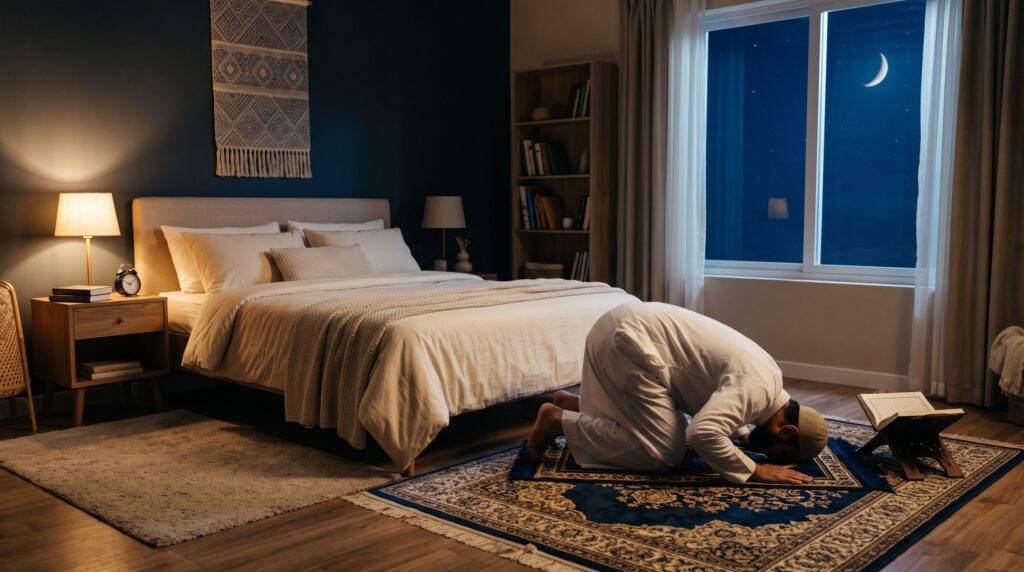
One of those prayers is Tahajjud.
It is authentically reported that the Prophet would stand in the night prayer so long that his feet would swell and crack. His beloved wife Aisha, may Allah be pleased with her, watched him and could not remain silent.
“O Messenger of Allah,” she asked, “why do you burden yourself like this when Allah has already forgiven your past and future sins?”
He looked at her and said, “Should I not be a thankful slave of Allah?”
SubhanAllah.
The same narration is reported by the companion Al-Mughirah ibn Shu’bah (RA) in Sahih al-Bukhari and Sahih Muslim.
This is the prayer we now treat with levity. The prayer we postpone with excuses of fatigue, work, and hustle.
Yet Qiyamu Layl, another name for Tahajjud, was not a casual act for him. He declared it “the best prayer after the obligatory prayers” [Sahih Muslim]. It was his refuge.
Aisha (RA) testified that he would pray seven, nine, or eleven rak’ahs in the depth of the night [Sahih Bukhari], alone with his Lord while the world slept.
We justify our modern hustle with “tie your camel,” but we forget that the one who taught us to tie the camel was the same one who stood at night until his legs swelled, not out of fear alone, but out of love and gratitude.
Perhaps the question is not whether we are busy. The question is: what are we too busy for?
The Honor of the Night
In the middle of the night, silence is the only thing you can hear, for most people are lost in slumber.
How spiritually appealing it is that you are answering the call of your Lord while others are snoring. You deny yourself the sweetness of sleep, not to chat with your soulmate on WhatsApp, nor to study your most difficult course, but to place your request before your Lord and thank Him for His Mercies.
You are fighting one of your ultimate desires. If you can combat that desire and neglect the whisperings of Shaitan at that hour, other temptations will not stand long before you.
The Messenger of Allah (PBUH) said:
“Paradise is surrounded by hardships and Hell is surrounded by desires.”
[Sahih Muslim]
This act creates a strong bond between you and Allah, for Allah, Exalted is He, is always pleased with those who remember Him.
It is no surprise that Tahajjud is one of the attributes with which Allah described the dwellers of Paradise:
“Indeed, they were before that doers of good. They used to sleep but little of the night, and in the hours before dawn they would ask for forgiveness.”
[Qur’an 51:16–19]
A Time for the Qur’an and for Forgiveness
The Qur’an is to be recited during Tahajjud just as it is recited in the obligatory salat. It is here that the believer’s love for the Words of Allah grows, for he reflects upon them and corrects his mistakes.
How many times do we feel we know a particular surah by heart because we studied it at the madrasah, only to realize we no longer remember it due to lack of constant revision?
Tahajjud gives you time to recite as long as you desire and to truly reflect upon the Mighty Word sent to our beloved Messenger.
The Prophet affirmed:
“Whoever prays at night reciting two hundred verses will be written down as one of the sincere devotees.”
[Sunan ad-Darimi & al-Hakim]
This is the hour of Divine proximity.
The Prophet said Allah descends to the lowest heaven in the last third of the night, asking:
“Is there anyone to invoke Me, so that I may respond to his invocation? Is there anyone to ask Me, so that I may grant him his request? Is there anyone seeking My forgiveness, so that I may forgive him?”
[Sahih Bukhari]
The opportunity for acceptance is even greater in Ramadan.
Allah’s Messenger said:
“Whoever prays the night prayer in Ramadan with firm belief and expecting a reward, his previous sins are forgiven.”
[Bukhari & Muslim]
Narrated Ibn Mas’ud (RA), the Prophet (PBUH) said:
“Our Lord wonders at two men: one who gets out of his bed and leaves his family to perform prayers. Our Lord says: O My angels! Look at this slave of Mine who got up from his bed and left his family to offer prayer, desiring what is with Me and fearing what is with Me.”
[Ahmad, Abu Daud, Ibn Hibban & al-Hakim]
Beware of Excess and Innovation
It is important to point out some innovated practices people have attached to Tahajjud.
Tahajjud should not be made obligatory for anyone, because the Prophet never did so. Nor should it be turned into a loud, advertised congregational vigil; pasting posters and inviting crowds to the mosque for “Tahajjud Night Parties.”
This is incorrect and an innovation which the Prophet warned against:
“Whoever innovates in this affair of ours will have it rejected.”
[Sahih Bukhari 2697]
Extremism is not allowed in Islam. We must not abandon the compulsory prayer while performing this optional salat.
One must not exhaust himself in Tahajjud and then sleep through Salat al-Fajr.
And a Muslim must not shout while praying in a way that disturbs his neighbours.
Allah says:
“Call on your Lord with humility and in private, for Allah does not love those who trespass beyond bounds.”
[Qur’an 7:55]
So go to bed early, so that you may rise to prostrate yourself to your Lord in the last third of the night.
- May Allah grant us acceptance of our deeds and supplications. Ameen.