
Aug
Money has ended more marriages than infidelity in some parts of the world—not because money itself is evil, but because people often enter marriage with different expectations, unspoken assumptions, and inherited beliefs about finances. One spouse believes saving is a sign of wisdom, while the other equates generosity with spending freely. One insists that every naira should be accounted for; the other feels that talking about money ruins romance.
Then there is the familiar phrase that has found its way into countless Muslim conversations:
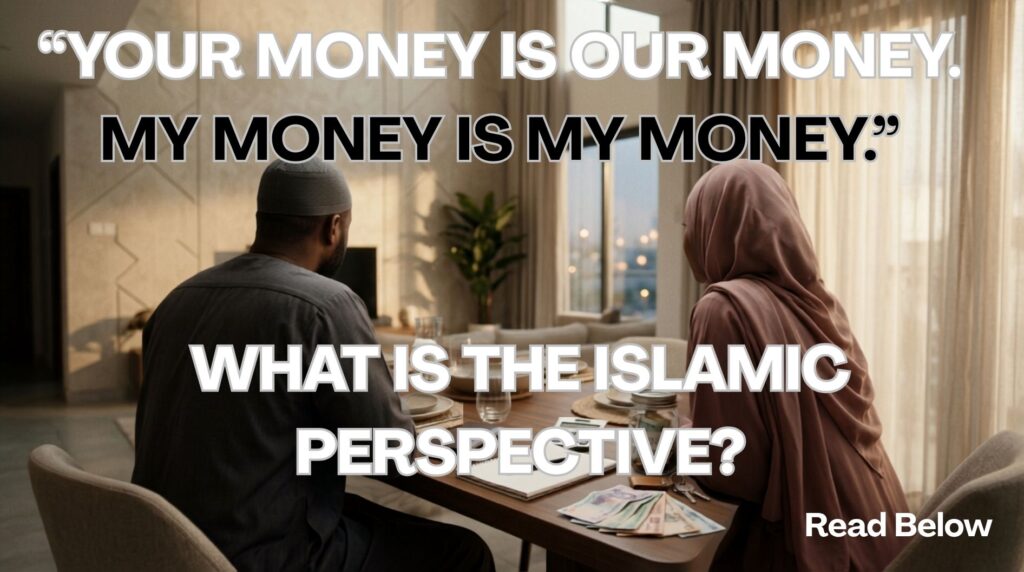
“Your money is our money, but my money is my money.”
It is often said jokingly by Muslim women, and sometimes repeated as though it were an established Islamic principle. At other times, it becomes a source of genuine resentment between husband and wife.
So, what does Islam actually teach about finances in marriage? More importantly, how can Muslim couples build a home where wealth becomes a source of barakah rather than bitterness?
The Husband Provides by Divine Responsibility
Islam places the primary financial responsibility for the household upon the husband.
Allah says:
“Men are the caretakers and maintainers of women because Allah has given some more responsibility than others and because they spend from their wealth…….”
Qur’an 4 (An-Nisa):34
This verse is often misunderstood. Being the provider is not a badge of superiority but a sacred responsibility. The Prophet ﷺ never portrayed financial leadership as a privilege. Rather, he taught that every leader is accountable for those under his care.
A Muslim husband should strive to provide according to his ability, not according to social media standards or societal pressure. Providing does not necessarily mean luxury; it means fulfilling the family’s essential needs with lawful earnings. A husband who sincerely works, earns halal income, pays the bills, and cares for his family is engaged in an act of worship.
Many husbands silently carry enormous financial burdens—rent, food, school fees, medical bills, and extended family responsibilities. Some suffer quietly because they believe asking for help makes them failures. Likewise, many wives sincerely wish to contribute but are never invited into meaningful financial discussions.
Healthy marriages replace isolation with teamwork. While the husband carries the primary responsibility of maintenance, the wife strengthens the home in countless ways. That support may include helping to create a realistic budget, avoiding unnecessary expenses, offering wise financial advice, or voluntarily contributing when circumstances require.
“Your Money Is Our Money…”
Let us address this popular statement directly.
From a legal perspective, Islamic scholars explain that the husband is obligated to provide for the family’s maintenance, whereas the wife is not obligated to spend her personal wealth on household expenses. In that limited legal sense, people summarize the matter by saying, “His money supports the family, while her wealth remains her own.”
However, this slogan misses the higher spirit of Islamic marriage.
Marriage is not built upon legal minimums but upon ihsān (excellence). If each spouse insists only on exercising their rights while neglecting generosity, love gradually gives way to accounting.
Imagine a husband saying, “I only have to provide food. Don’t ask me for anything else.” Or a wife saying, “I earn a substantial income, but I’ll watch you struggle because my salary is mine.”
Both may argue from the perspective of legal rights, but neither reflects the prophetic model.
Islam establishes rights to prevent oppression, but it encourages generosity to cultivate love.
One of Islam’s greatest contributions to women’s rights came centuries before many modern legal systems recognized them. A married woman has complete ownership of her wealth. Her salary, inheritance, business profits, investments, and gifts remain exclusively hers.
She is under no Islamic obligation to spend her money on household expenses.
This financial independence was revolutionary fourteen centuries ago.
Yet understanding this right should never lead to misunderstanding its spirit. If Allah blesses a wife with wealth while her husband faces financial hardship, it is among the noblest acts of kindness and charity for her to support her family voluntarily.
No example illustrates this better than Khadijah bint Khuwaylid (رضي الله عنها). She was one of Makkah’s most successful businesswomen and possessed wealth independent of her husband. Yet when the Prophet ﷺ received revelation and faced severe persecution, she did not guard her wealth while watching him struggle.
She comforted him emotionally, strengthened him financially, and spent generously in support of Islam. The Prophet ﷺ never demanded her wealth; she gave willingly because sincere love often exceeds obligation.
This remains one of the greatest financial lessons in Islamic history.
The healthiest Muslim marriages are not built by asking, “What is the least I must give?” Rather, they flourish when both spouses ask, “What more can I give for the sake of Allah?”
Islamic marriages thrive on selflessness, not selfishness.
Five Habits of Financially Healthy Muslim Homes
1. Discuss Money Before It Becomes a Problem
Many couples spend more time discussing wedding decorations than financial expectations. Couples should openly discuss income, debt, spending habits, family obligations, savings, and long-term financial goals. Silence breeds assumptions, and assumptions often lead to disappointment.
2. Live Below Your Means
The Prophet ﷺ lived a simple life despite having opportunities for greater worldly comfort. Today, many people increase their standard of living whenever their income increases. While there is nothing inherently wrong with enjoying Allah’s blessings, financial peace often comes from wanting less rather than earning more.
Contentment (qanā’ah) is one of the greatest forms of wealth.
3. Build a Family Budget Together
A budget is not a restriction—it is a roadmap. It helps couples know where their money goes and ensures that spending aligns with shared priorities. Reviewing the budget together regularly promotes transparency, strengthens communication, and builds trust.
4. Prepare Before Emergencies Come
Unexpected expenses are, in reality, inevitable. Illness, job loss, accidents, or urgent family needs can arise without warning. An emergency fund protects not only your finances but also your marriage from unnecessary stress.
The believer plans responsibly, hopes for the best, and places complete trust in Allah.
5. Give Charity Together
One of the greatest secrets of financial barakah is generosity.
Some families possess little yet experience immense blessings because they give sincerely for Allah’s sake. Others enjoy abundance yet never feel satisfied because greed has consumed their hearts.
When couples give charity together, they remind themselves that wealth is an amānah (trust) from Allah, not merely a personal possession.
Allah says:
“………whatever you spend in His cause, He will replace it, and He is the Best of Providers.”
Qur’an 34 (Saba):39
Money is a Mirror
Money has a remarkable way of revealing what lies beneath the surface. It exposes our fears, priorities, insecurities, and even the strength of our reliance upon Allah.
Financial disagreements are rarely just about money. More often, they reflect deeper issues of communication, unmet expectations, gratitude, or differing visions for the future.
The strongest Muslim homes are not necessarily those with the largest incomes. They are the homes where husband and wife see themselves as teammates rather than opponents. They celebrate one another’s successes, carry one another’s burdens, and remember that every blessing they possess is an amānah from Allah.
Take some time this week to sit with your spouse and have a meaningful conversation—not merely about how much money you have, but about the financial legacy you wish to leave behind.
Ask one another:
- Are we using our wealth in ways that bring us closer to Allah, or merely closer to the lifestyle we desire?
- If one of us lost our income tomorrow, would we face the challenge as partners or as individuals?
- How can we increase the barakah in our home through generosity, gratitude, wise stewardship, and trust in Allah?
Never forget that your bank balance is not the true measure of your family’s success—your marriage is.
A home in which the husband fulfills his responsibilities with sincerity, the wife supports with wisdom and compassion, and both place their trust in Allah is far richer than a mansion filled with wealth but empty of peace.
As you review your finances, do not ask only, “How much did we earn?” Ask the more important question:
“Did our wealth help us become a family that Allah loves?”
For in the end, the greatest financial achievement is not leaving behind a large inheritance, but leaving behind a family that knows how to earn lawfully, spend wisely, save responsibly, and give generously for the sake of Allah.